
San Antonio Foundation Repair
Table of Contents
Foundation Repair Essentials in San Antonio, Texas
In San Antonio, Texas, foundation repair plays a vital role in safeguarding homes and commercial buildings against the region’s challenging conditions. Expansive clay soils here swell with summer rains and shrink during droughts, causing foundation problems that affect slab-on-grade and pier-and-beam structures common in the area. These cycles lead to structural stabilization needs, as outlined in the San Antonio Residential Construction Guidelines, which emphasize compliance with local building codes to address soil-related challenges and ensure safety.
At bluebonnet foundation repair Texas, we bring over 40 years of combined experience as a family-owned business, delivering expert foundation repair you can trust. Our licensed and fully insured team specializes in foundation underpinning using proven concrete and steel push piling piers for lasting stabilization. We focus on personalized service, understanding the unique indicators of foundation issues in the San Antonio area to prevent escalation of damage.
We start with free inspections and estimates, providing transparent written proposals based on observed conditions–estimates are subject to change per our terms. Most residential repairs complete in one to three days, with comprehensive warranties detailed in service contracts. Addressing concerns like timelines and costs, we guide clients through drainage correction and leveling to restore stability.
This overview highlights the essentials; upcoming sections explore signs of foundation damage, causes, and best practices for effective repairs in San Antonio.
Understanding Foundation Problems in San Antonio
Homeowners in San Antonio often face unique challenges with their foundations due to the region’s soil and weather conditions. At Bluebonnet Foundation Repair, we frequently encounter issues that require prompt attention to prevent minor problems from escalating. Understanding foundation repair in San Antonio, Texas, starts with recognizing early indicators, which can save significant costs and maintain structural integrity over time.
Common Signs of Foundation Damage
Have you noticed cracks forming in your walls or doors that no longer close properly? These are classic signs of foundation damage in San Antonio homes, where expansive soils can exert immense pressure on structures. According to Texas Real Estate Commission standards, visible indications like diagonal wall cracks wider than 1/4 inch or sloping floors signal potential adverse performance that warrants reporting. In our experience, uneven floors often manifest as a noticeable tilt in tile or carpet, while sticking doors and windows arise from frame distortions caused by foundation settling symptoms. Exterior heaving, particularly after heavy rains, pushes slabs upward, creating bulges in driveways or patios. We differentiate cosmetic cracks, which are hairline and superficial, from structural ones that zigzag through mortar joints and indicate deeper shifts. Local examples include post-storm shifts in Alamo Heights neighborhoods, where clay soils expand and contract dramatically.
To self-inspect, follow this checklist:
- Check interior walls for cracks exceeding 1/8 inch.
- Test doors and windows for resistance.
- Use a level on floors to detect slopes over 1 inch in 10 feet.
- Examine exterior for heaving or separation gaps.
Early detection allows for targeted interventions like foundation underpinning to stabilize your home.
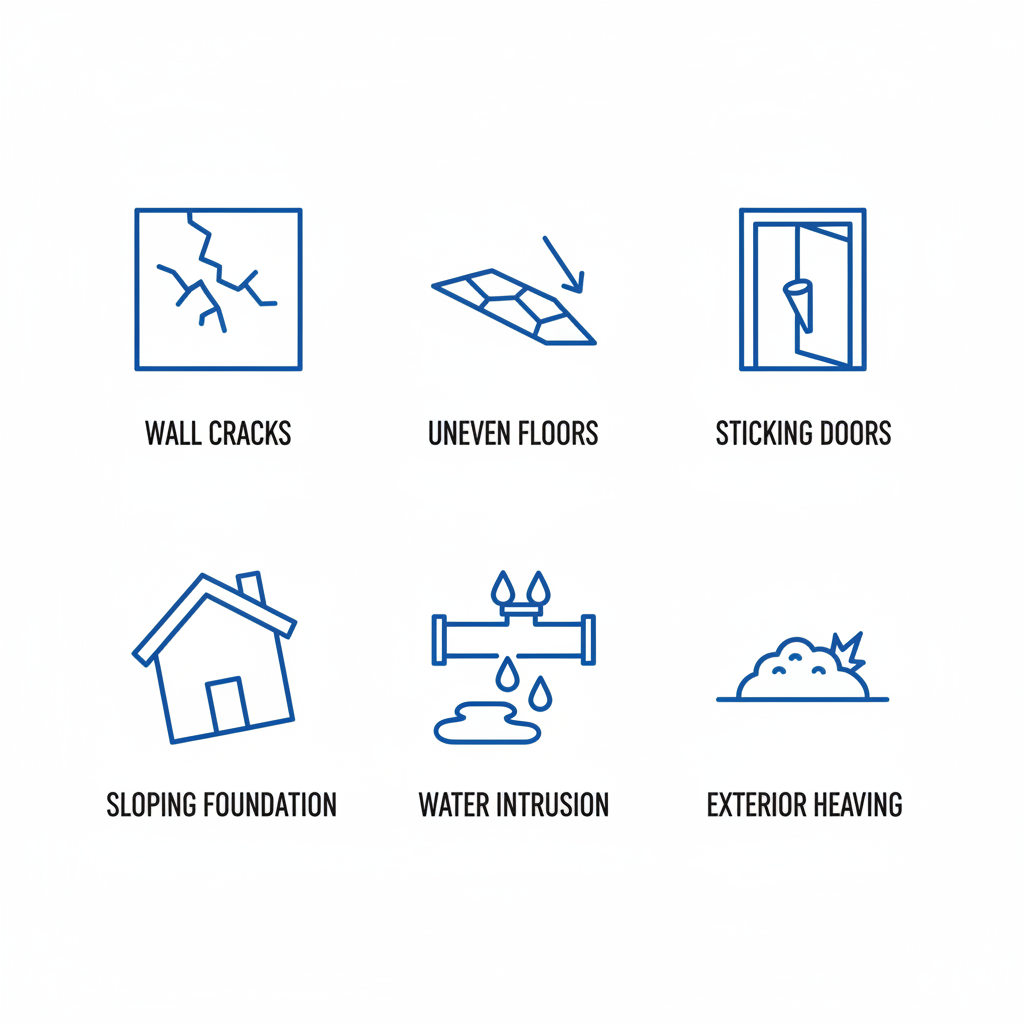
Visual icons of common foundation problems in San Antonio homes
These visual cues help San Antonio residents quickly assess their properties, but professional verification ensures accuracy. Transitioning to underlying causes provides further context for prevention.
Causes Specific to San Antonio Soils and Climate
San Antonio’s black clay soils, known for their expansiveness, swell with moisture and shrink during dry spells, leading to soil-related structural shifts. This phenomenon, detailed in ASCE resources on foundation strengthening, causes clay to expand up to 30% in volume when wet, exerting pressures exceeding 5,000 pounds per square foot on home foundations. Poor drainage around slabs directs water toward the base, accelerating erosion beneath, while mature tree roots absorb moisture unevenly, creating voids that promote settling. Drought conditions, common in Central Texas, exacerbate shrinkage, pulling foundations downward and resulting in cracks. Climate variability, with intense summer heat and sudden floods, amplifies these effects, as seen in widespread issues following 2023’s erratic weather patterns. We observe that unaddressed plumbing leaks contribute by saturating surrounding soil, mimicking natural expansion cycles.
For mitigation, monitor grading to ensure 5% slope away from your home and prune trees at least 10 feet from foundations. Consult experts in Texas foundation repair services for soil testing to identify vulnerabilities early.
Understanding these regional factors underscores the need for timely assessments, especially as symptoms accumulate.
When to Schedule an Inspection
If multiple signs appear simultaneously, such as cracks alongside uneven floors, it’s time to act without delay. In San Antonio, seasonal factors like the rainy spring or dry summer heighten risks, making inspections urgent after heavy precipitation or prolonged droughts that trigger soil movement. We recommend scheduling when symptoms persist beyond temporary settling, such as doors sticking consistently or water pooling near the foundation, which could indicate progressive damage. Early warning signs of sinking foundation, like small exterior gaps widening over months, demand attention to avoid costly escalations. Based on our free inspections and estimates protocol, urgency increases if issues affect livability, like sloping that impacts mobility.
Key triggers include:
- New or widening cracks post-weather events.
- Functional problems in multiple rooms.
- Visible soil shifts or heaving outdoors.
- Any safety concerns, such as stair instability.
Contacting professionals promptly, we provide transparent evaluations to guide next steps and preserve your investment.
Benefits of Professional Foundation Repair
At Bluebonnet Foundation Repair, we understand the critical role that reliable home stability plays in San Antonio properties. Engaging professional foundation repair in San Antonio, Texas, offers substantial advantages, particularly through our expertise in concrete and steel push piling piers. These methods provide professional stabilization advantages that protect against the region’s expansive clay soils and seasonal flooding. By addressing signs of foundation damage early, such as cracks or uneven floors, homeowners can avoid costly escalations and ensure long-term repair outcome benefits. Our family-owned business, with over 40 years of combined experience, delivers transparent foundation repair services Texas tailored to local needs, including free inspections and comprehensive warranties.
Cost Savings from Timely Repairs
Timely intervention minimizes expenses by preventing minor issues from becoming major structural failures. In San Antonio, foundation repairs typically range from $5,000 to $20,000, depending on factors like soil type and damage extent–expansive clays here can exacerbate settling, leading to higher costs if ignored. Early detection of signs of foundation damage allows us to use efficient techniques like push piling, avoiding secondary problems such as water intrusion that could double repair bills.
Evidence shows that delaying repairs often results in widespread issues; for instance, post-flood scenarios in areas like the San Antonio River basin have seen unchecked settling lead to plumbing failures and mold growth, inflating expenses by 50% or more. We deliver savings through precise assessments and competitive pricing, completing most residential jobs in one to three days to reduce disruption. Local programs enhance affordability: the USDA’s Section 504 Home Repair program offers loans up to $40,000 at 1% interest for very-low-income Texas homeowners, while San Antonio’s Minor Repair initiative provides grants for health and safety fixes in low-to-moderate income households.
For San Antonio residents, these options make professional services accessible, ensuring cost-effective solutions for Texas properties.
Enhanced Structural Safety and Longevity
Foundation underpinning strengthens home integrity for safer living environments and extended property life. Our push piling methods involve driving concrete or steel piers deep into stable soil layers, then lifting and leveling slabs to restore even support–this process eliminates risks like wall cracks or door misalignment that signal instability.
Safety enhancements are evident in our licensed, insured team’s approach; with 40+ years of experience, we prevent collapses by addressing underpinning needs when homes show excessive settling, often necessary after heavy rains common in South Texas. Underpinning not only stabilizes but also improves load distribution, reducing stress on beams and joists. Real-world examples from San Antonio’s post-storm recoveries demonstrate how our techniques have safeguarded families, with piers engineered to withstand local soil shifts for decades of reliability.
We focus on durable outcomes for Texas homes, providing peace of mind through proven stabilization that aligns with regional building codes.
Access to Free Inspections and Warranties
No-obligation assessments build trust by identifying issues without upfront costs, paired with solid guarantees for lasting confidence. Our process starts with a thorough free inspection, where we evaluate soil conditions and recommend customized plans using push piling for optimal results.
These services underscore our commitment: inspections reveal hidden problems like drainage issues, allowing proactive repairs that warranties then protect–our contracts detail coverage for materials and labor, subject to site-specific conditions. Homeowners appreciate this transparency, especially in San Antonio where variable weather demands reliable partners. By tying into USDA grants up to $10,000 for seniors or city programs for major rehabs, we make quality care attainable, avoiding scams through our established, family-owned operations.
This approach delivers comprehensive benefits for local properties, ensuring secure and valued investments.
How Foundation Repair Works
At Bluebonnet Foundation Repair, we specialize in providing reliable foundation repair in San Antonio, Texas, using proven techniques to address issues in slab and pier-and-beam structures. Our process begins with a thorough assessment and progresses through precise installation and restoration, ensuring long-term stability for homes affected by expansive clay soils common in the region. By employing concrete and steel push piling piers, hydraulic lifting, and targeted drainage corrections, we deliver effective solutions tailored to local conditions.
The Inspection and Planning Process
We start every project with a free, no-obligation inspection to identify potential problems. This involves a visual examination for signs of foundation damage, such as cracks in walls or uneven floors, followed by precise level measurements using advanced tools and basic soil analysis to evaluate moisture and load-bearing capacity. These steps help us pinpoint the extent of settling or shifting caused by soil movement.
- Conduct an on-site walkthrough to document visible indicators.
- Measure floor elevations and compare against original plans.
- Sample soil properties, considering San Antonio’s expansive clays that require deeper support per local guidelines.
Based on these findings, we develop a custom repair plan that complies with San Antonio Residential Construction Guidelines, including permit applications through the Development Services Department. This planning phase ensures our strategies align with city codes for safety and durability, adapting to site-specific factors like nearby utilities or slope. Typically, this preparation takes less than a day, allowing us to provide a transparent written estimate outlining the scope, timeline, and costs influenced by soil conditions and foundation type–results may vary, so we recommend consulting our licensed team for details.
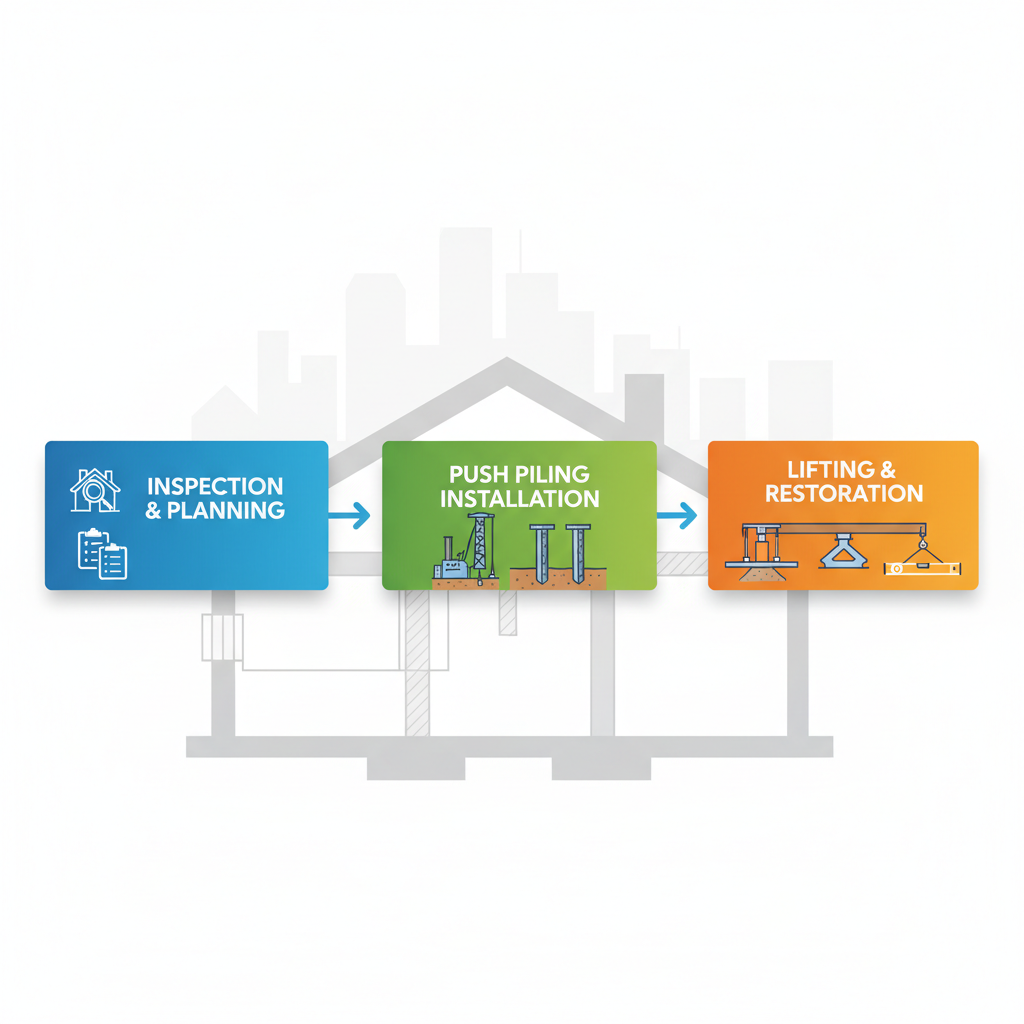
Step-by-step diagram of Bluebonnet’s foundation repair process
This diagram outlines our streamlined approach, highlighting how initial diagnostics inform the entire procedure and lead seamlessly into stabilization efforts.
Push Piling Pier Installation Techniques
Once planning is complete, we focus on foundation underpinning through push piling, a key stabilization technique that transfers the structure’s weight to deeper, more stable soil layers. We offer both concrete and steel piers, selected based on soil analysis and load requirements–concrete piers provide robust compression strength, while steel options excel in tension resistance for pier-and-beam systems.
The pier installation process begins with hydraulic equipment to drive piers vertically beneath the foundation until they reach refusal, often 10-20 feet deep in Texas expanses as recommended by ASCE engineering standards for underpinning in reactive soils. This method differs from traditional excavation by minimizing disruption and ensuring precise placement.
- Mark pier locations around the perimeter and interior load points.
- Drill pilot holes if needed, then insert and push piers using synchronized jacks.
- Test each pier’s capacity to confirm it supports at least 20 tons, verifying load transfer.
In San Antonio, we adapt these techniques to handle seasonal soil expansion, answering common queries about the best underpinning methods by emphasizing push piling’s reliability over alternatives like helical piers for slab foundations. This phase typically spans one day, with our insured crews following strict safety protocols to protect the property.
Lifting, Leveling, and Restoration Steps
With piers securely installed, we proceed to lifting and leveling using synchronized hydraulic systems that gradually raise the foundation back to its original position. This controlled process monitors stress distribution to avoid further cracking, restoring uniformity across the slab or beams.
- Connect hydraulic rams to the foundation via pier caps.
- Incrementally lift sections, checking levels every few inches.
- Secure the structure once aligned, then address any voids with grout.
Finally, we handle restoration, including concrete repairs for cracks and spalling through our concrete repair services Texas, alongside drainage corrections to prevent future water intrusion. Site cleanup ensures minimal impact, with most residential projects wrapping up in one to three days. Our family-owned team, backed by over 40 years of experience, prioritizes compliance and warranties detailed in service contracts, empowering homeowners with lasting results adapted to Texas conditions.
Best Practices for Foundation Maintenance
Maintaining your home’s foundation is essential for structural longevity, especially when considering foundation repair in San Antonio, Texas, where expansive clay soils pose unique challenges. At Bluebonnet Foundation Repair, we emphasize proactive strategies that prevent costly issues and ensure lasting stability. These practices complement our expert services, helping homeowners safeguard their investments through informed maintenance.
Preventive Drainage and Soil Management
Effective drainage and soil management form the cornerstone of foundation health in regions with shifting soils. We recommend installing French drains around the perimeter to redirect water away from the foundation, preventing soil saturation that leads to uneven settling. Extend gutters at least five feet from the home and ensure downspouts direct runoff to landscaped areas. For soil management, maintain a slight slope in grading away from the structure and aerate compacted clay to promote better water absorption. In advanced cases, consider foundation underpinning to stabilize deeper layers, particularly if initial signs indicate movement.
These measures mitigate the risks of expansive Texas clay, which swells with moisture and contracts during dry spells, a common trigger for foundation shifts. By addressing drainage proactively, homeowners reduce the likelihood of cracks and uneven floors, saving on future repairs. Rationale includes preventing hydrostatic pressure buildup, which can exert thousands of pounds against walls.
In San Antonio, where monsoons intensify these issues, landscaping with native, drought-resistant plants like buffalo grass helps manage moisture without overloading soil. We advise consulting professionals for custom plans to align with local codes (80 words tips, 50 rationale, 20 local).
Routine Inspections and Monitoring
Regular inspections are vital for catching signs of foundation damage early, such as hairline cracks, sticking doors, or sloping floors, which may signal underlying shifts. We advise homeowners to perform quarterly visual checks after heavy rains or droughts, examining basement walls and exterior slabs for new fissures wider than 1/8 inch. Use simple tools like a crack gauge to monitor progression and a level to detect floor tilts over time.
- Walk the perimeter to spot uneven settling or gaps in brickwork.
- Check interior for drywall cracks or misaligned baseboards.
- Document changes with photos for professional review.
If monitoring reveals persistent movement, involve experts promptly, as foundation underpinning may become necessary when cracks exceed monitoring thresholds. Typical repairs in San Antonio take one to three days, depending on scope, allowing quick resolution without extended disruption.
This approach empowers proactive structural care, aligning with search intent for preventive checklists. Local resources like the San Antonio Housing Support program’s Minor Repair initiative offer eligibility for low-income households to fund inspections, ensuring accessibility (bulleted guide integration, 150 words total).
Choosing Reliable Repair Providers
Selecting a trustworthy provider ensures quality outcomes for any foundation needs, including pier and beam repair Texas. Look for teams with Texas licensing, full insurance, and over 40 years of combined experience, like our family-owned operation at Bluebonnet Foundation Repair. Verify they offer comprehensive warranties and transparent, no-obligation estimates based on thorough inspections.
Key criteria include proven use of concrete and steel push piling piers for permanent stabilization, adherence to local building standards, and post-repair follow-ups–we provide free annual checks to monitor long-term performance. Avoid DIY limits; always hire certified professionals for hydraulic lifting and site restoration to prevent further damage.
For funding, the USDA Single Family Housing Repair Loans and Grants program supports very-low-income homeowners with up to $40,000 in loans at 1% interest or $10,000 grants for those 62+, ideal for maintenance budgets in rural Texas areas. This reinforces community-focused maintenance strategies, positioning us as a reliable partner for San Antonio homeowners seeking durable solutions.
Securing Your San Antonio Home Foundation
In San Antonio, Texas, foundation repair addresses the unique challenges posed by expansive clay soils that cause shifting and cracking in home structures. Homeowners often notice early signs of foundation damage, such as uneven floors or wall cracks, which signal the need for prompt intervention to prevent costly escalations. At Bluebonnet Foundation Repair, we specialize in expert foundation repair you can trust, using proven concrete and steel push piling piers for lasting stabilization.
Recapping the essentials, common causes stem from soil movement due to moisture fluctuations, leading to visible indicators that demand professional assessment. Our repair processes, including foundation underpinning and leveling, typically complete in just one to three days, offering cost-effective solutions with transparent estimates and comprehensive warranties. These efficiencies ensure minimal disruption while safeguarding your property’s value. For long-term foundation health, regular maintenance like monitoring drainage and addressing minor issues early promotes structural security in this region.
As Texas homeowners, we encourage proactive steps aligned with Texas Real Estate Commission guidelines on reporting foundation performance. Estimates reflect observed conditions and may adjust based on site specifics, with warranties detailed in contracts. For peace of mind, contact us today for a free inspection through our foundation repair contact Texas page. Secure your home’s foundation with Bluebonnet–serving Texas since 2006 with family-owned dedication.
Resources
Apply for USDA Rural Home Repair Loans and Grants in Texas
Verify Texas Real Estate Licenses and Foundation Inspection Standards
Access San Antonio Low-Income Home Repair and Rehab Programs
Learn Foundation Underpinning Methods in ASCE Engineering Webinar